Our Regulars
Our Regular Damian on writing, reading, and Uncle Vanya

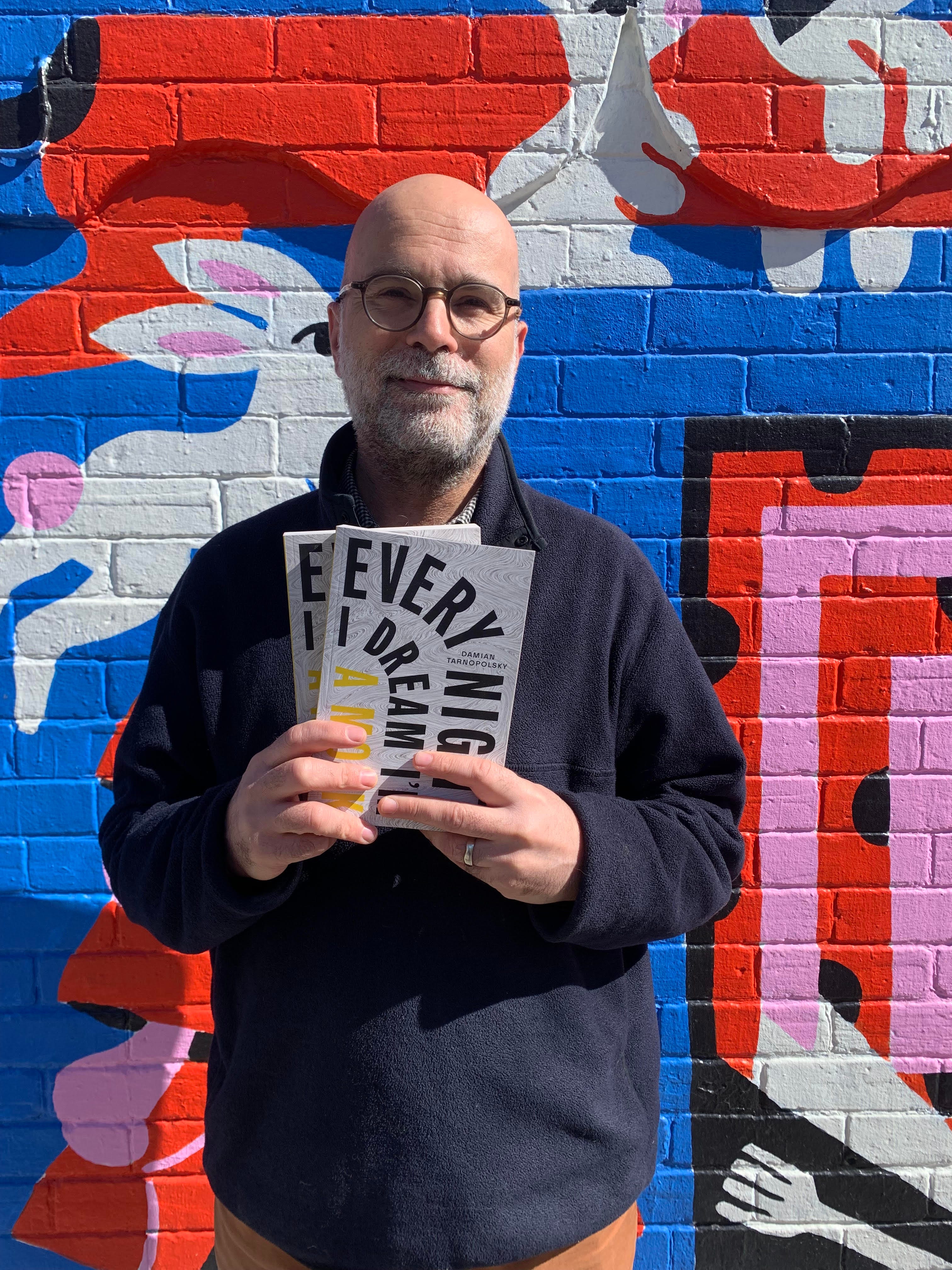
Damian Tarnopolsky is a writer, teacher, and friend of TYPE Books Junction. I first met him back when he dropped off a galley of his short story collection Every Night I Dream I’m a Monk, Every Night I Dream I’m a Monster, and since then the store has sold books at his local launch and he’s published a chapbook called A Friend to Words. I have been looking for the right time to talk to him for The Juncture. So when he told me he also works as a writing teacher to medical professionals it clicked (me now working full time in a hospital). Read on to learn about the Narrative-Based Medicine Lab at Continuing Professional Development, part of the Temerty Faculty of Medicine at the University of Toronto, the way his teaching contrasts from his own writing, and how he does cover versions of stories that have inspired and moved him.
– Max
On his favourite play:
Uncle Vanya, by a mile, is my favorite play. It’s terrifically sad, complex, and immersed in so many different stories of the family members. At various points in my life, different characters have spoken to me. I used to feel like the more ambitious, younger ones, and now that I feel at a kind of midpoint, the looking-back-looking-forward characters are speaking to me. I don’t want to identify too much with Vanya himself because he’s in such a tragic situation. But as time goes on, and I do have a melancholy sort of streak, I find myself absorbed by him. I think it’s the kind of Russian sense of life having gone by and your opportunities not having turned into what you thought they were going to be. You see different versions at different times in your life and they speak to you differently. I remember seeing a movie version, Vanya on 42nd Street, with Wallace Shawn and Andre Gregory, which opens with the actors arriving and talking to each other and chatting, and then you very gradually realize the play itself has started. But the best one I ever saw was a couple of years ago at Crow’s Theatre with Tom Rooney. I went on a Wednesday, and then I went back on a Saturday to see it again, just to absorb every moment of it.
On teaching doctors how to write fiction:
This is one of those happenstance things that I never planned. Originally, I had a fellowship at Massey College where I taught medical residents interested in writing. It’s become more professional over time. I taught at the Centre for Faculty Development at St Mike’s Hospital and now I’m doing it at Continuing Professional Development (CPD) at U of T.
Essentially what we’re doing is recognizing and understanding that everyone in the health community or in the healthcare experience is immersed in a story already: the story that you’re telling yourself as a patient of what’s going on with you, the story that practitioners are telling themselves, about each other, about their experience, about their patients. It’s not imposing narrative on medicine as much as revealing the presence of narrative in all these encounters and experiences that sometimes end up determining our lives. I am trying to teach people to get better at working with the elements of story and literary elements and narrative elements. The idea being that if you can handle those better as a writer and as a reader, not only does that have benefit for you as a person, but it can also affect your healthcare work. Though that part is taught much more directly by a colleague of mine, Karen Gold. She sits with practitioners and physicians and takes them through ways to think differently, and work narratively with their patients.
It’s unique in my experience, teaching writing and literature to people who are so hungry to be in class and devoted to the work. They do the reading, they do the homework. They have fascinating life experience to share. And they want to improve. They’re searching, at times, for a return to an interest that they had years ago that they’ve never been able to develop. They’re searching at times for some relief or recompense from the very devastating experiences of institutional indifference or outright hostility, working under incredibly challenging burdens and stressful conditions, day in, day out. Some of them feel like the clinical medical chart is a limited form for all the things a practitioner and a patient are experiencing and thinking. They come to class holding these stories, not necessarily wanting to tell them, but asking: What happens to them? They’re hungry for the satisfactions of literature.
On how his own writing differs from what he teaches:
I find that most people in the courses that I’m teaching are looking to give a sort of shape to their stories that will allow them to communicate it to somebody else, or to understand it better themselves. And then my own writing, it’s more kind of: how’s this story going to break things up for you or make you look at them differently? The book that I have out right now, Every Night…, is quite fragmentary and quite challenging to read, people tell me, and not a smooth or satisfying narrative at all. Every Night …. is almost a novel, almost a collection of stories, that follows a particular character over time as he goes through destructive experiences and conflicts. It moves between narrators, between stories, between forms to try to capture something about him over time. My aim is: what’s happening with these characters? What’s happening with those stories? What can I do to keep myself interested? I might get kind of bored with this person 30 pages down the line so how can I turn it around to keep the reader interested and keep myself interested? It’s much more linguistic-interest or story-interest or character-interest, as opposed to setting out and thinking I’m going to do something experimental, or I’m going to write a story that’s different from all these other kinds of stories that I’ve read in order to prove some point or make some idiosyncratic kind of gesture about literature.
On doing a cover version, but in writing:
My chapbook, A Friend to Words, is an adaptation of a Zen short story by Nakajima Atsushi called “The Expert”, about the myth of the archer who wants to be able to do archery without a bow and without an arrow. When I read that story twenty years ago, it felt like having my head split open. It was this shattering, wonderful experience I’ve never been able to put aside. One of the things I’m doing now is going back to those stories that marked me and reading them again and rewriting them in cover versions. You have your habits and grooves as a writer, the ways of structuring things. You have your modes that you’re not even terribly conscious about, about how you’re approaching time or narration. But reading “The Expert,” oh okay, we’ve just jumped through thirty years in a paragraph; we just jumped from one character to another within a sentence. I didn’t think you were allowed to do that. And the voice is a kind of fabular, folk voice. And I wondered, what would it be like for me to do that? If you’re a painter in a workshop, the teacher tells you, you need to paint this calf now, you need to paint this thunderbolt coming out of the clouds. It’s something that I instruct my students to do: read this carefully and mimic and copy. So I’m kind of finally teaching myself. It is a powerful way to learn and it’s a lot of fun.
On his interactions with TYPE Junction and what he’s currently reading:
Well, I love the store. I remember when it opened it was such a delight to have TYPE here with us. I was going through rough times when I first walked by the window and part of me wanted my book to be in my neighborhood. When the book came out I actually took a picture of it in the store window because I was so delighted, so happy to see it there. It’s one of those rare experiences in your life. I come by every so often to say hi to it. There’s a great pleasure and interest in our neighborhood store, and delight in seeing it thrive, and seeing our friends here. A busy bookstore is a sign of a great neighborhood.
Marta Bátiz has a glorious book out now, A Daughter’s Place, which is a telling of the story of Cervantes, the author of Don Quixote. It focuses on his daughter, though, how she was present in the writing of that novel and how she was excluded from his family and excluded from his history. And it has telenovela vibes. A book that I’ve been returning to again and again is A Horse at the Window by Spencer Gordon, who’s a fantastically interesting and original and poetic writer. That book has those Zen elements I was getting at in my chapbook. I also love Andrew Kaufman’s deep, dark, dirty story collection Enjoy Your Stay at the Shamrock Motel. Finally, I recently went to a reading and heard Caitlin Galway read from A Song for Wildcats. The two stories she read were so original and lyrical that, inevitably, I ended up buying the book after having promised myself: “No buying any other books this month.”