Maker's Mark: Paul Dotey
Friend of The Juncture, Paul, talks linocut, Hot Pizza, and the craft of window displays

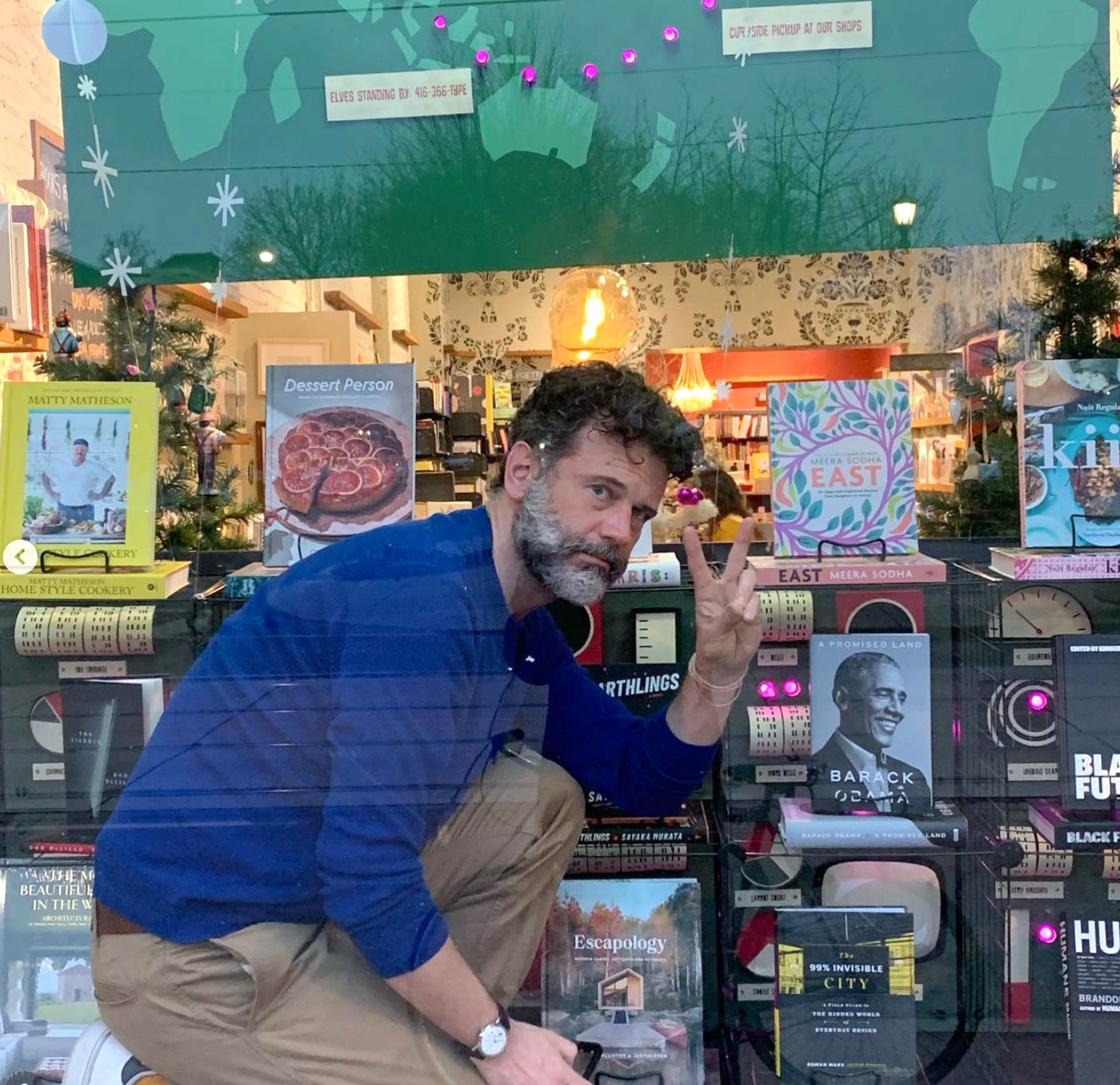
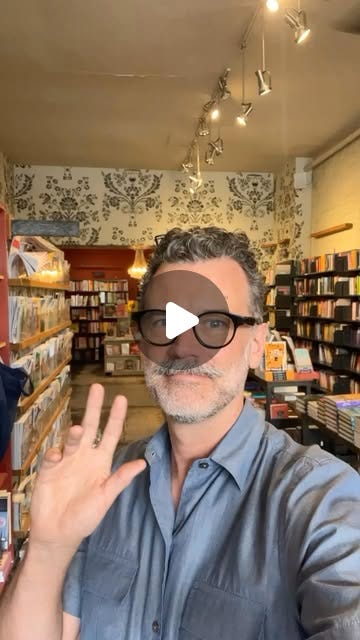
For the better part of ten years, Paul Dotey was a mainstay at the Queen Street location of TYPE Books. His book recommendations were admired, his window displays fawned over, his company sought after. But like all good things that come to pass, in 2024 Paul left TYPE to focus full-time on his art practice.
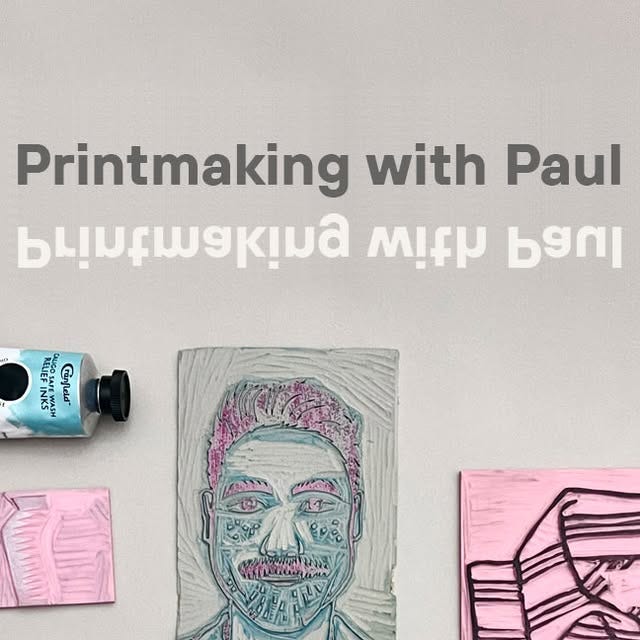
Soon, Paul will start teaching a six week class at Hot Pizza Studios (an art studio located here in the Junction) to introduce students to relief printmaking, using rubber and lino blocks to create prints on paper and textiles. And Paul’s work can still be spotted in the Junction, where we’re still sometimes graced by his touch in our windows, ie these most recent Summer and Winter seasons.
Recently, Paul and I took a stroll through the Church Wellesley Village, and talked about reading habits, nuclear families, art exposure, and whether it’s important to finish every book you start.
— Josh
Josh: How has your reading practice changed since you left TYPE?
Paul: I think I’ve only read 3 books this year. I’m out of the loop a little bit in what is brand new.
So I’ve let myself fall back into rereading a couple of things. I reread The Handmaid’s Tale. I was thinking “I’ve been talking about this book alot, I should go back and read it.” Oh, and I’ve got a nice big fat stack of original Hardy Boys. My stepdad said, “You’ve got these Hardy Boys in the basement.” There’s like 25. They’re hardcovers!
J: Were you ten the last time you read those?
P: I don’t remember reading them.
I think I inherited them and never read them. The ones I read were the Hardy Boys Case Files, and they were meant to be more mature.
J: Sure, I remember those – the Hardy Boys are in high school.
P: Yeah. They deal with more crime. There would be more guns and violence. In the first book, Frank Hardy’s girlfriend is killed in a car bomb and that sets the tone for this much darker series, where he’s grieving. The moral tone of the original series from the ‘50s is really striking, in that sort of gentle nudging towards proper behaviour. The boys knew to be home by 5 o’clock because mother would have dinner on the table. There’s always this reinforcement that your family comes first, there are manners, and your mother has dinner ready at five, so don’t be rude.
J: That’s nuclear family mores right there.
P: Exactly. They’re always polite. In one story they mentioned an immigrant family. The father was a mechanic in town, he’d been framed for a crime, and everyone in the family knew that they were poor, they’d just come from Italy after the war. Southern European immigrants were dirt poor in the period after the war, and the books find an interesting way of framing people. It was of a time and a place.
J: Are there other Young Adult books that draw you in for the same reason?
P: When I was at TYPE I could sell the Beverly Cleary books, the Ramona series, because what was presented in those books was such an amazing slice of America in the 1950s.
If one person on the street got a car, that was news. Only one person on the street had a TV set. The lucky guy who had the big job is the one who had the TV set. You can roll your eyes when you read some of those books because they’re very dated and they’re very puerile, but they’re also a really interesting snapshot of North America in a very specific time and place.
J: It resonates with me that your reading habits have changed now that you’re not in the store. Last year, I had a moment where I’d read a few new releases in a row and I didn’t love any of them. The joy had come out of it a little bit. And I thought: “I think I need to demarcate between what’s reading for myself and what’s reading for work.” So I would read for work for three weeks. Then I would read for myself for three weeks.
P: Also, If you’re not enjoying a book, put it down. How often do you just push yourself to finish the 700 page novel? How many times do you flip away from a song or a TV show or a movie if it’s not interesting you? I just read a really fantastically crappy book. A little bit of a thriller, a little bit of a future-set dystopia. Oh my god. And that one, I did not finish. It felt great to put it down. It felt wonderful. You have this feeling that you have to be morally upright and finish every book you start. You do not!
J: Do you want to take the alley up to Isabella, maybe? Wait – does this alley go anywhere?
P: Yes, it will.
J: Do you know where Neil Young lived on Isabella?
P: No, Neil Young lived on Isabella? Shut up!
J: Should we look it up and go see?
P: Yes. That’s great.
J: How long did you work at TYPE?
P: Almost ten years! The fall of 2024 would have been my 10th anniversary, but I left in July.
J: How long did you do windows for the Queen St. store?
P: Kalpna was doing windows for the first few years when I started. So I think I did windows for about six or seven of the nine years I was there.
J: How many windows, approximately, do you think that makes?
P: Maybe thirty? I’m thinking I did four a year. I kept a digital record. I took a lot of photos of the windows I did, but I know that I missed a few. I was just thinking of that the other day. There’s a few ones I really regret not photographing.
J: There’s no exit to this laneway.
P: No, apparently not.
J: OK let’s turn back. Do you have a favourite window?
P: My first window is one of my favourites because that was honestly the first 3D piece I’d ever made. I’d always been a drawer and a painter, and the printmakers have always worked two-dimensionally. That window was honestly the first thing I’d sculpted. I taped out the measurement of the front window depth on my floor and I built it in my apartment. I was very chuffed with myself because I knew that the window dressers at Barneys in New York City would build all of their windows at a warehouse in Queens.
J: And you were doing it in your apartment!
P: I do it in my apartment, baby! It was a good one. It was a Valentine’s window. I built these two sweet little desks, and I found the perfect light green paper to make the legs and bodies of the desks. It was that perfect enamelled green that we all grew up with in our schools. I incorporated kids’ Valentines going back and forth to each other. Anyway, it was a nice success.
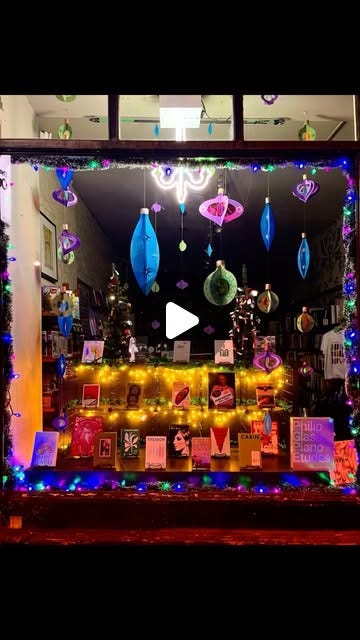
And then there’s a window I did for Christmas, which is all folded paper Christmas lights. And I ended up just going so crazy, making them, I made more than I needed, and I think I probably had about eighty. I just kept hanging them and hanging them.
J: Well, you’ll be happy to know that those paper lights are in the basement of our store in the Junction. We put them up every year.
P: Oh nice! Good! I remember a very sweet moment. There was a mom in the store talking to another mom, and they were looking up at the lights, and one mom said to the other: “We tried making those ourselves last weekend. It did not go well.” I thought, oh, that’s cute. Some little kid having a little meltdown because they can’t quite fold the lights in the same way.
J: Imitation is the most intense flattery, right?
P: I think that Christmas window is probably my best, actually. My most favourite.
J: Tell me about this upcoming class you’re teaching at Hot Pizza Studio?
P: I’ve been at Hot Pizza Studio for a year. This March break will mark a year, because one of the first things I did was on March break camp last year. And I’ve done some PA days, I’ve done some summer camps. I’ve done a few one-offs. I’ve done a couple of adult classes, and I’m about to start a six-week long series of Thursday nights starting the first two weeks of March and then all of April. Each session is two hours of print-making, introducing people to linocut and rubber stamp printing. Some really nice basics.
Two hours is enough time to really make a mess, and then think about what you’re doing the next week when you come back. Oh boy, just the act of getting an adult out of their regular life for two hours where the only thing they’re required to do is make something...Wooh, stand back, because nobody sits around twiddling their thumbs!
They know that time is valuable and they enjoy it. It’s just like the kids that I teach regularly, some kids are just nose in, they know exactly what they’re doing, so don’t get in their way. Some other kids, and some other adults, want assistance. They want to talk about what they’re making. They want to run it past you, and they want to see it, sort of, filtered through your ears or your eyes and just want to hear you say: “Yes, do it. Make it!”
J: After six weeks, how vast of a project can someone expect to come out with?
P: There’s a lesson every class, and I’m not really thinking about an overall project. In week one, I’ll introduce the class to some simple rubber stamping, then move into lino. I want to open up the idea that if we’re working on something today, and you did something last week you still want to work on, just ignore me and keep working. Because that’s what I really enjoyed about what I’ve learned, I guess, from being at Hot Pizza: it’s really not a school. Julia Dault’s been very clear that it’s a studio.
It is a place to make things. It’s not curriculum based. There’s certainly no pass or fail. We’ll talk about what we’re doing today, and here are some supplies, here are some lessons. We’re going to draw some portraits of each other; we’re going to do ‘Wanted’ portraits. So here’s a great way to draw eyes and get the proportions right. If you don’t want to do it, don’t do it. And if you want to make a fort for your dog out of cardboard, do that. Here’s the cardboard, here’s the glue. I’m not gonna stand in your way.
J: When you see the kids having fun at Hot Pizza, and you think back to yourself, how different was your upbringing with art? And does that inform what you want to bring to the kids of today?
P: The word is ‘exposure’. I had a mom who was an art teacher and I think the main thing I benefited from was ‘exposure.’ The stuff was just there in the house and I was allowed to play with it. You know, there were a few types of paint that I wasn’t allowed to touch because they were expensive. But by and large, I was allowed to use X-ACTO blades and rubber cement and cutting knives and different types of paper, and I knew my paper thicknesses.
One of the things we love about Hot Pizza is that the studio is overflowing with stuff. There’s a fantastic mountain of cardboard. It’s a fantastic mountain of fabric.
J: How do you get a kid to come out of their shell?
P: Some kids, they really know what they’re doing. They came here guns blazing, ready to make some art. And other kids are still sort of struggling with it, especially at the beginning of the day when mom or dad just dropped them off. They’re not firing on all cylinders. But I make sure that whatever it is they’ve done, it’s awesome: “Oh my god, so much orange. I love orange. I see you love orange.” Just let them know that whatever they made is fantastic.
It’s not just the youngest, it’s sometimes physically the smallest kid in the class. Parents dropped them off and they’re very reticent. They are very shy. And I’m sort of thinking, “Oh, boy, there might be some tears later in the day.” But it’s those kids to watch. Like maybe 9 o’clock, 10 o’clock, 11 o’clock, they’ll come out of their shells and by the end of the day, that’s when they’re firing on all cylinders. So I learned to really give kids the time to warm up.
Soon after, our walk came to its end outside the address, 88 Isabella Street, where Neil Young had once lived during his days in the Yorkville folk music scene. What Paul and I saw, as we’d predicted, was a gravel hole in the ground, slated to, in the near future, become a condo tower. Google Maps, however, still shows the midcentury apartment building that replaced the rooming house, a white-bricked mid-rise not dissimilar to the building in which Paul lives a few blocks away, a building also slated for gentrification. It’s a given that nothing stays the same, but there’s still plenty of good stuff, as Hot Pizza demonstrates to us – the need for art, the spark of creating, the blossoming of imagination – that remain forever the same.
The Relief Printmaking class taught by Paul Dotey starts on March 26th, and runs for 6 consecutive Thursdays. Register here.